EU Battery Regulation · from 18 February 2027113 days left
Every e-bike battery needs its own passport
From 18 February 2027, each e-bike and e-scooter battery sold in the EU needs a digital passport behind a QR code. IonPass gets small brands ready: battery data once per model, a QR label for every battery and a passport page for each one.
From €99 a month. Passports stay online, even if you cancel.
- Made in Europe
- Account data stored in the EU
Battery · CityPack 500Li-ion NMC · 36 V · 500 Wh
Who it’s for
The passport belongs to whoever places the finished battery on the EU market. Find your situation.
E-bike brands
Your brand on the battery, or complete bikes you import.
For brands →Pack assemblers
Finished packs under your own name or your customer’s.
For assemblers →Importers
E-bikes, e-scooters, e-mopeds and spare batteries from outside the EU.
For importers →Refurbishers
Remanufactured and repurposed batteries get a new passport.
For refurbishers →
Not sure it applies to you?
If you fit a drive maker’s system battery sold under its own name, the passport is usually that maker’s, not yours. Answer up to five questions to see whether your batteries need one, and who provides it.
What IonPass does
From the spreadsheet you have today to a passport behind every battery.
Step 1 · Data
Enter your battery data once per model
Fill in the Annex XIII fields for each battery model and see which ones are required on day one. Every battery of that model inherits them.
Step 2 · Labels
Print a QR label for every battery
Import serial numbers from a spreadsheet and download print-ready QR labels, with one unique identifier per battery.
Step 3 · Passport
Publish a passport page per battery
Each QR code opens a public passport page, with restricted sections for parties with a legitimate interest and an export in the Battery Pass data model.
Inside the dashboard
These are real screens from IonPass. Click through them, or try the demo yourself: nothing you change is saved.
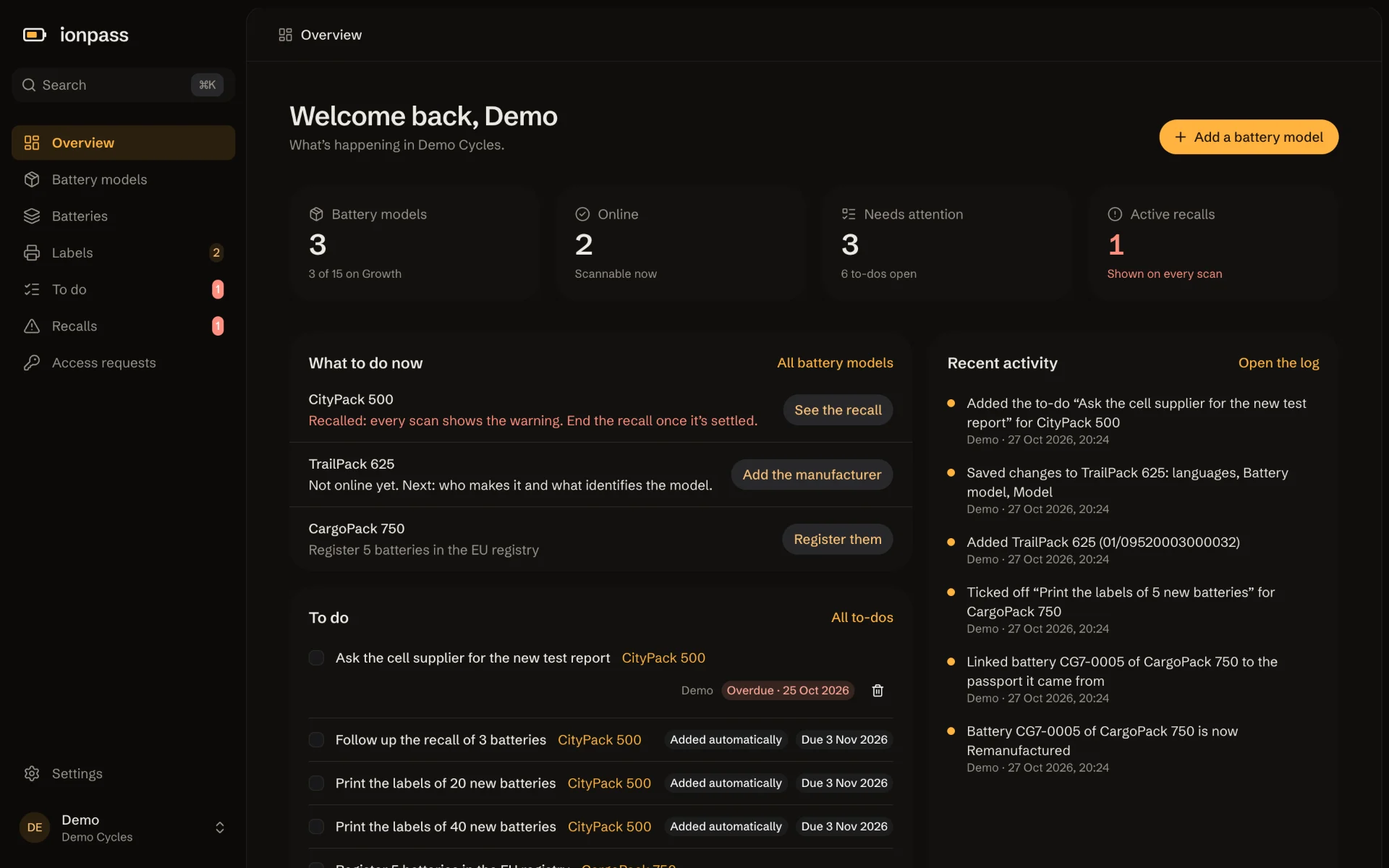
Try it with one of your batteries
Fill in one of your batteries, see its passport and scan it with your phone.
113
Days until 18 February 2027
Why now
Since 18 August 2024
The EU Batteries Regulation applies: batteries placed on the market need CE marking and a declaration of conformity.
18 February 2027
Every battery for light means of transport, industrial battery above 2 kWh and EV battery placed on the EU market needs a battery passport behind a QR code.
Later
Carbon footprint and recycled content join the passport once their detailed EU rules apply.
Pricing
Pay for the number of battery models you sell. Published passports stay online even if you cancel. Choose a plan when you open your account.
Starter · For a small range
€99/month
- Up to 3 battery models
- Up to 5,000 batteries a year
- QR labels and passport pages
- Export in the Battery Pass format
Growth · For a growing range
€249/month
- Up to 15 battery models
- Unlimited batteries
- API for serial numbers and state of health
- Priority support in English, German and Dutch
Prices exclude VAT, billed monthly.
Does this apply to you?
Which batteries need a passport?
Batteries for light means of transport (e-bikes, e-scooters and similar), industrial batteries above 2 kWh and electric-vehicle batteries placed on the EU market from 18 February 2027. Each individual battery gets its own passport.
Who is responsible: the brand or the supplier?
The company that places the finished battery on the EU market. Often that is the brand, but it can be the pack assembler or the importer. Cell suppliers can provide data, but the responsibility stays with that company.
We use a drive maker’s system battery. Do we need IonPass?
Probably not for that battery: the maker that sells it under its own name provides the passport. You may still need one for batteries you sell under your own brand, such as spare packs or range extenders.
What has to be in it on day one?
General information about the model, such as manufacturer, chemistry, capacity, weight and hazardous substances, plus data per battery such as the serial number and, for batteries with a battery management system, the state of health. Carbon footprint and recycled content follow later, once their detailed EU rules apply.
Is this legal advice?
No. IonPass helps you prepare and keep your data in order. Check your obligations with your own adviser.
Be ready before 18 February
Open your account and give your batteries their passports, or look around the dashboard’s demo first.
From €99 a month. Passports stay online, even if you cancel.